Next-gen argoforester urges climate action
- Billy Higgins
- Nov 1, 2021
- 3 min read

September 27, 2021
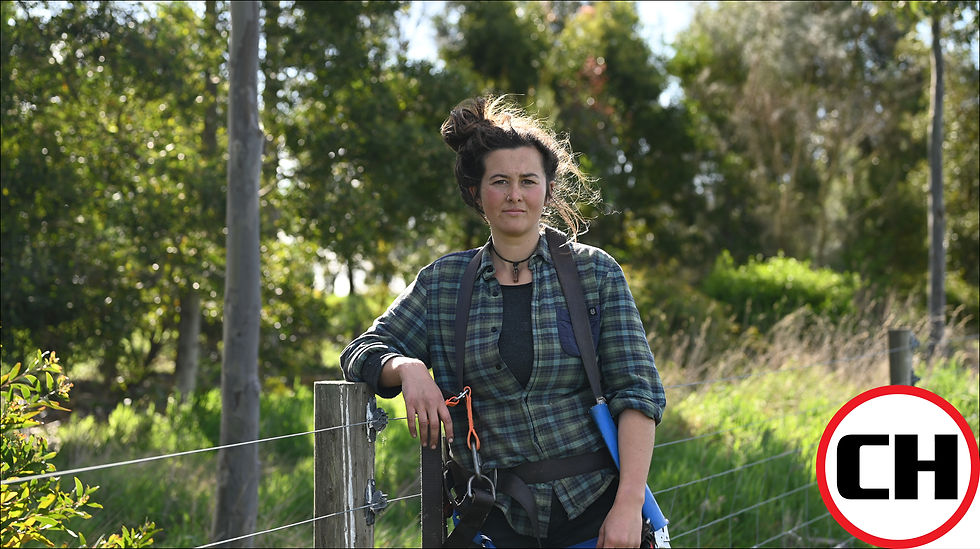
Deans Marsh farmer Kristy Stewart says it’s time agriculturalists had their voices heard in national climate discussions.
Ms Stewart is taking a hyperlocal commitment to sustainable farming to the federal stage, as a new generation of producers who fear their environment-dependent industry will be first to suffer from ongoing climate impacts.
The young Deans Marsh farmer is part of the newest generation of Yan Yan Gurt West farm’s Stewart family, who have pioneered eco-friendly farming for decades.
A focus on landcare through agroforestry and revegetation has earned widespread acclaim for the family – most recently a Bob Hawke Landcare Award for family patriarch Andrew earlier this year.
But as the new generation Ms Stewart is aiming higher, and has joined action group Farmers for Climate Action, a nation-wide movement to unite producers’ voices in calling for action on climate change from the country’s leaders.
“I joined FCA because our family has always been pro-environmental farming practices. I feel like as farmers we need to have a stronger voice in the climate change space, to lobby governments so there’s more action in that area,” she said.
“I wanted to be involved in a group that was doing that and have that as a resource for me for information around climate change action and to have a network of like-minded people.”
FCA provides expert advice and educational programs for farmers passionate about climate change, like Kristy.
It also lobbies political leaders to take firmer stances about climate targets.
A petition to the federal Nationals leader – “Tell Barnaby Joyce that farmers want meaningful climate action” – has almost 6000 signatures, and there are thousands more signatures on similar petitions to other state and federal MPs.
The pressure comes as climate hots up as a key issue in the upcoming federal election, likely to happen early next year.
There’s increasing friction within the federal Coalition on the contentious issue; Treasurer Josh Frydenberg on Friday said there was “extensive discussions” and “good progress” towards a Federal Government commitment to net-zero by 2050.
But Nationals leader Mr Joyce has repeatedly rejected calls for a definitive carbon-neutral target for Australia that would bring it closer in line with other countries, on the basis that regional Australians would bear the brunt of its costs.
Ms Stewart said she was worried the price of inaction would substantially outweigh sacrifices of reaching a net-zero goal.
“Farmers are at the coalface with climate change. Our livelihoods is working out in the environment,” she said.
“The projections aren’t looking very pretty. That’s going to make it a lot more difficult for us to do a good job farming.
“Farmers can play a really critical role in not just the reduction of climate emissions but also in proofing the landscape to be more resilient to the more drastic weather patterns and changes that we’re going to be seeing going into the future.”
The Stewarts have walked the walk when it comes to sustainable farming in the Colac district.
The family has revegetated 18 per cent of their property with no loss of stock.
Ms Stewart says the extra trees and shrubs provide more shade and shelter for animals, protection against wind and supports landscape health.
Recent analysis of carbon modelling also indicates the farm has become a carbon sink – that is, it removes more carbon from the environment that it produces.
But carbon is just one aspect of the eco-friendly focus, with the integration of trees and shrubs supporting biodiversity values and land regeneration that underpins landscape health.
Their issue is getting paid for it, and helping other sections of their industry jump on board.
Ms Stewart said more targeted and streamlined funding schemes for sustainable farms would incentivise other farmers to participate in similar practices.
“The soil carbon credit has legs, but farmers need to be better supported to get those baseline carbon measurements – I’ve been wanting to do it for years but I can’t afford it,” she said.
“There’s so much potential for farmers to become carbon sinks just through reveg and then on top of it to do soil analysis.
“If we can just get better education and support from the government, it would go a long way to deal with some of the climate crises that we’re going to be facing.”
While Ms Stewart admits a solution to wide-ranging problems is complex, she has called on governments to increase their support for agriculture to allow it to the lead the way for Australia’s climate future.
“That comes down to part of the education extension and the political will as well, and the national conversation we’re having about carbon – that should just as much be including the importance of land regeneration and biodiviersity and other aspects that are so integral for the health of landscapes,” she said.
“We need more people in the farming sector to speak up about this – we really need stronger rules around this before it’s too late.”


Comments