Segmenting accounts for better social media marketing results
- Billy Higgins
- Nov 22, 2021
- 2 min read


Brands encounter a fundamental problem when they begin executing social media strategies: their customers, on the whole, don’t really want to hear from them.
Of course, this statement is a generalisation. But it’s true that social media users are on their sites of choice because they want to hear from and interact with people they know, not from brands. This is intuitive to the about 80 per cent of Australians that use social media sites, and research backs it up. Social media brings the internet full circle back to its originally planned use: for the exchanging of information between users with minimal influence from corporations.
This principle hasn’t stopped brands from trying to engage with their target markets via social media, and nor should it – it’s basic marketing practice to maximise reach by communicating through the channels your customers are using. But perhaps it provides a hint of new strategies that brands can use to engage their customers in different ways and in different forms to maximise efficiency.
This idea came to me while reading Aleti, Harrigan, Cheong and Turner’s (2016) analysis of how Australia’s brewing industry influences its consumers on Twitter. Their research found that small, microbreweries have a surprisingly large share of the sector’s Twitter audience. Craft breweries accounted about 90 per cent of its Twitter voice, despite only holding about two per cent of market share.
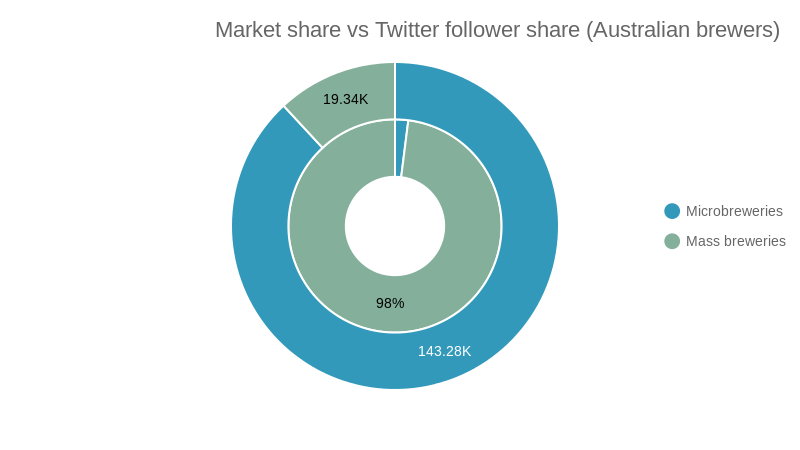
Despite only accounting for a tiny portion of market share (inside), microbreweries outperform their mass-producing rivals in Twitter engagement. Data: Aleti, Harrigan, Cheong and Turner (2016); chart: Chart Blocks
What does this tell us? Firstly, that there is apparently zero correlation in this example between social media engagement and macro business performance outcomes. But in terms of supporting a businesses’ social media marketing strategy, it occurred to me that smaller accounts have far greater cut-through with their intended audiences than non-personal, mass communication from brands can achieve.
Again, this is partly intuitive. Users are more receptive to messages that come from trustworthy sources, without any obvious selling motives. Personal, individualised communications also yield better results than that which is widely distributed.
One idea to capitalise on these concepts could be for brands to use accounts under the guise of a staff member to engage with customers from a more personable perspective. The accounts needn’t be completely removed from the brands either – conglomerate CEOs like Jeff Bezos and Elon Musk can use their profiles to extract more engagement than Amazon and Tesla as well as small microbreweries, so this concept holds sway from top to bottom.
Accounts don't even need to hide their business affiliation to achieve great Twitter results.
Another plan could be for businesses to create sub-accounts for different departments, which could help account managers segment their audiences and provide more relevant content and engagement to customers.
Such a fragmented approach would of course create challenges to achieving successful integrated marketing communications by aligning all messages from a number of different accounts. It also creates a resources issue, because more people and hours being involved will obviously affect costs.
Developing any sort of framework or deep, evidence-based investigation into the effectiveness of such a strategy is unfortunately beyond the jurisdiction of this humble blog. But the ideas at least can prompt the question: should brands use individual accounts to better engage with their customers?


Hi Billy! I think what you have mentioned about the correlation between communication in smaller accounts having more interaction and influence over larger brands is fairly relatable to what I have mentioned in my blog ‘Consumer see, consumer do’. Small brands with established communities online seem to perform better as they are characterised to be more similar to influencer marketing, whereby the ability to have personalised communications within these established niche communities tend to “yield better results”. Whereas widely distributed communications tend to have good reach and exposure but poor engagement similar to celebrity endorsements strategies.
So my answer is yes, brands should definitely use individual accounts that enable more personalised engagement with their consumers. This will help achieve consumer…